All men's bones
All men's bones

|
Basel's dance of death, The ossuary.

|
Holbein's dance of death alphabet.

|
 ow the dance of death starts to the sound of drums and trumpets.
It's not hard to see where Holbein has found the inspiration: His hometown
Basel had two famous dances of death
and both of them start in the same way.
The picture to the left is from the beginning of the so-called
Groß-Basel dance of death.
ow the dance of death starts to the sound of drums and trumpets.
It's not hard to see where Holbein has found the inspiration: His hometown
Basel had two famous dances of death
and both of them start in the same way.
The picture to the left is from the beginning of the so-called
Groß-Basel dance of death.
In Holbein's picture, as well as in Basel's dances of death, one Death beats the drum and plays the fife,
while the other blows a horn. In the background an untold number of skulls are piled up.
This makes it possible to prove that Holbein's dance of death alphabet is older than
his great dance of death: The alphabet follows the model (Basel's dance of death)
much more closely than the great dance of death does (see picture to the right).
Jakob von Wil's dance of death in Lucerne

|
The dance of death in Wasserburg

|
Holbein's dance of death has also inspired the dance of death in Lucerne from ca. 1610 and the dance of death
from the former ossuary in Wasserburg from 1837.

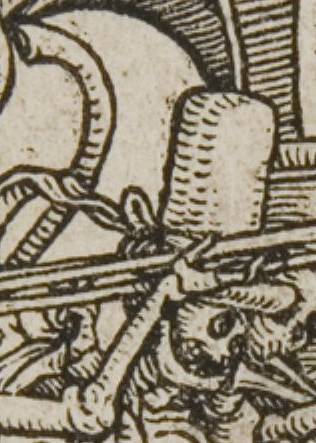
Tall hat

|
In the middle of the crowd one of the Deaths wears a tall hat with long ribbons.
It's the same hat that Death is wearing
before the king
(letter D),
before the nobleman
(letter K),
the girl
(letter S)
and on the
Holbein dagger.
Variations: The various artists follow Holbein's original rather closely.
A small variant is that Birckmann adds what looks like a "marine trumpet"
(see the page about the peddler for details).
The interesting part is that Valvasor copies the marine trumpet on his picture.
Various Artists
Petri Paaw (1615)

|
Magasin pittoresque (1869)

|
 Dances of death
 Holbein's dance of death
All men's bones
Holbein's dance of death
All men's bones