Lübeck's Dance of Death

The Physician

Translations and notes are to be found below.


The physician

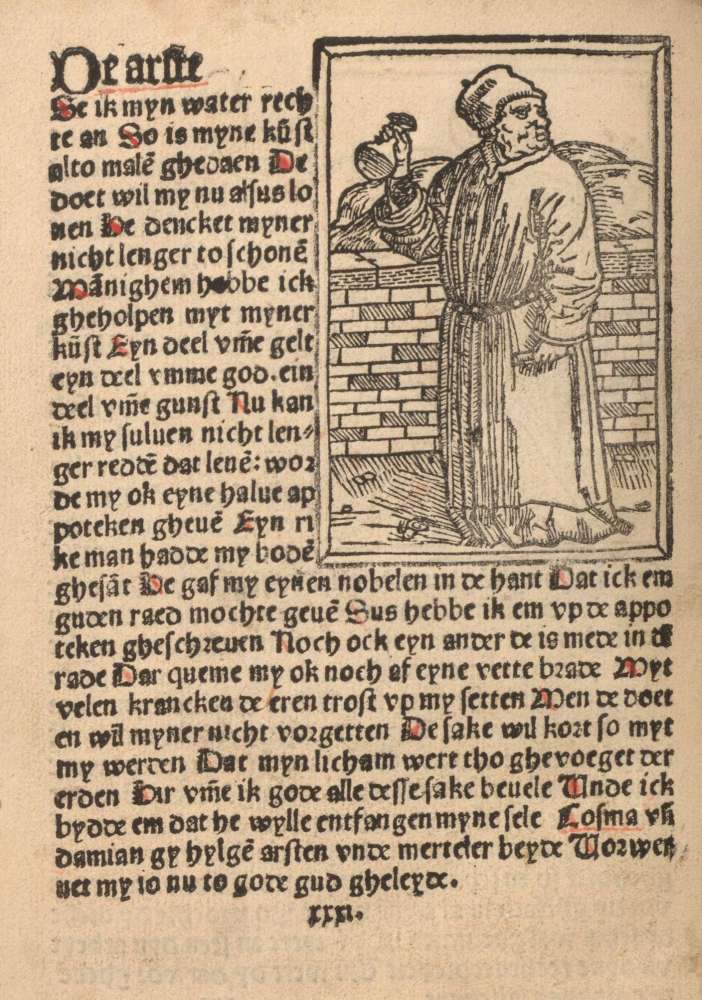
De Arste

Se ik mîn water rechte an,
So is mine kunst altomalen gedân.(1)
De dôt wil mi nu alsus lonen;
He denket miner nicht lenger to schonen.
Mannigen hebbe ik geholpen mit miner kunst,
Ein dêl umme gelt, ein dêl umme Got, ein dêl umme gunst.
Nu kan ik mi sulven nicht lenger redden dat leven,
Worde mi ôk eine halve appoteken geven.
Ein rike man hadde mi boden gesant,
He gaf mi einen nobelen in de hant,
Dat ik em guden rât mochte geven;
Sus hebbe ik em up de appoteken geschreven.
Noch ôk ein ander, de is mede in dem rade,
Dâr queme mi ôk noch af eine vette brade,
Mit velen kranken, de eren trôst up mi setten,
Men de dôt en wil miner nicht vorgetten.
De sake wil kort so mit mi werden,
Dat mîn lîcham wert togevoget der erden.
Hîrumme ik Gode alle desse sake bevele
Unde ik bidde em, dat he wille entvangen mine sele.
Cosma unde Damiân, gi hilgen arsten unde mertelêr beide.
Vorwervet mi jo nu to Gode gût geleide.

 
Death with scythe

De doet

Her doctor, vele hefstu gesecht van dinen kranken,
Nu beginnestu sulven ôk sere to anken.
Got is de hogeste arste unde de beste,(2)
He helpet êrst unde ôk in dat leste.
He sleit unde maket wedder gesunt alle dage
An sele, an live na sinem behage.
Men schal den arsten eren, so heft Salomon geschreven;
Hîrumme en schal sik dîn herte nicht vorheven.
Wente sulven kanstu di nicht gehelpen klein noch grôt,
Men Got mach di helpen ût aller nôt.
Dat deit he gerne, wente he is vul gnaden,
So vern du de armen nicht hefst so sêr beladen
Unde hefst to vele geldes van en genomen,
Al was en dat ôk weinich to hulpe komen.
So we dat wil, dat sik Got siner schal vorbarmen,
De schal ôk barmhertich wesen over de nôtroftigen armen.
De hilgen arsten unde mertelêr Cosma unde Damiân,
De hebben dit alsus mit vlite gedân.
De minschen arstedieden se an sele, an live ût rechter mildicheit,
Dârto leten se sik mertelen dorch den loven der cristenheit.
Diner mêsterschop en schal allene nicht tohoren,
Dattu alle tît scholest gelt upboren,
Men meist umme leve dine kunst dorch Got bewisen;
Nicht du allene, men al de sik an kunst der arstedie prisen,
Dat si in dem hovede, in den benen, efte in dem magen;
Den kranken to Gode reisen, dat belonet Got to ewigen dagen.


The Physician

If I see my water correctly,(1)
then my [medical] art is completely done.
Death will now reward me thus.
He no longer means to spare me.
I have helped many people with my [medical] art.
Some for money, some for God, some to be in good graces.
Now I can no longer save my own life,
even if I were given half a pharmacy.
A rich man had sent for me;
he gave me a noble(2) in my hand
that I might give him good advice.
Thus I wrote him [a prescription] for the pharmacy.
Furthermore another person, who is in the city council;
there I also received a fat roast [as payment].
There are many ill people who put their trust in me
but Death will not forget me.
It will shortly befall me
that my corpse will be added to the earth.
Therefore I commit all these things to God
and I pray to him that he will receive my soul.
Cosmas and Damian(3), both of you holy physicians and martyrs,
now give me good escort to God.

Death

Mr. Doctor, you have said much about your sick [patients];
now you also begin to complain much yourself.
God is the highest physician and the best;(4)
he helps first - and also in the last.
He strikes [with illness] and makes healthy again all days.
In soul, in body, as he pleases.
You shall honour the physician - thus has Solomon written(5)
but still your heart shouldn't raise itself to high
since you cannot help yourself [neither] little nor great.
But God can help you out of all distress;
he does this readily because he is full of mercy
insofar as you haven't strained the poor too much,
and have taken too much money from him,
even when it [the cure] didn't help him much.
So he who wishes that God should have mercy upon him,
he must also [himself] be merciful towards the needy poor.
The holy physicians and martyrs Cosmas and Damian(3) -
they have done it thus with diligence:
They cured people in soul, in body, out of real charity,
furthermore they let themselves suffer martyrdom through love for Christianity.
Your mastery should not only mean,
that you should always earn money,
but rather prove your love for your [medical] art through God.
Not you alone, but all those who take pride in their medical art -
be that in the head, in the leg or in the stomach.
To rouse the sick to God - that will God reward until eternal days.(6)

The physician Death to the physician Click the small pictures to see the original pages.

See the page about the Black Death.

(1) Water...: Urine glass. Indispensable part of medieval medical science. Notice the flask in the physician's hand.

(2) noble...: a former gold coin of England, first issued in 1346 by Edward III, equal to half a mark or 6s. 8d., replaced in 1464 under Edward IV by the rose noble (thank you mr. Webster).

(3) Cosmas and Damian...: Patron saints of physicians and surgeons. The two twins practised their healing for free, but were tortured and decapitated under Emperor Diocletian - presumably in 287.

(4) God is the highest physician and the best? I thought God was responsible for the plague, as a punishment upon humanity.

I wonder whom Death considers the second best physician. Typhoid Mary?

(5) Sirach 38,1: »Honour a physician with the honour due unto him for the uses which ye may have of him: for the Lord hath created him.«

(6) to rouse the sick to God... It is strange that the physician suddenly is requested to perform clerical work. It should be noted that the physician is regarded as ecclesiastical because he has studied - in contrast to the barber-surgeon or sawbones who is regarded as a craftsman.

This explains that the physician appears between 2 lay people, the mayor and the nobleman. You might see this note about the overall sequence.


Back to the Mayor Forward to the Young Nobleman Up to Des Dodes Dantz