Læge, Kærlig Adelsmand og Adelskvinde
Læge og adelsmand.

|
Dethe to the Phisician
Maister of phisik / whiche [o]n ȝowre vryne
So loke and gase / & stare a-ȝenne the sunne
For al ȝowre crafte / & studie of medicyne
Al the practik / & science that ȝe cunne
Ȝowre lyues cours / so ferforthe ys I-runne
Aȝeyne my myght / ȝowre crafte mai not endure
For al the golde / that ȝe ther-bi haue wonne
Good leche is he / that can hym self recure.
Døden til Lægen
ȝowre vryne: your urine
look, gaze and stare against the sun
leche: læge (egl.: blodigle)
The Phecissian answereth
Ful longe a-gon / that I vn-to phesike
Sette my witte / and my diligence
In speculatif / & also in practike
To gete a name / thurgh myn excellence
To fynde oute / a-ȝens pestilence
Preseruatifes / to staunche hit & to fyne
But I dar saie / shortli in sentence
A-ȝens dethe / is worth no medicyne.
Lægen svarer
in theory and in practice
thurgh: through
hit: it, fyne: end
Dethe to the amerous Squyere
Ȝe that be Jentel / so fresshe & amerous
Of ȝeres ȝonge / flowryng in ȝowre grene age
Lusti fre of herte / and eke desyrous
Ful of deuyses / and chaunge yn ȝowre corage
Plesaunt of porte / of loke & [of] visage
But al shal turne / in to asshes dede
For al beaute / is but a feynte ymage
Whiche steleth a-wai / or folkes can take hede.
Døden til den kærlighedsfulde adelsmand
eke: også
The Squyer answereth
Allas allas / I can now no socoure
A-ȝeyns dethe / for my selfe prouyde
Adieu of ȝowthe / the lusti fressh floure
Adieu veynglorie / [of bewte and of pride]
Adieu al seruyse / of the god cupide
Adieu my ladyes / so fresshe so wel be-seyne
For a-ȝeyne dethe / no thynge mai abide
And wyndes grete / gon doune with litel reyne
Adelsmanden svarer
Dethe to the Gentilwoman amerous
Come forthe Maistresse / of ȝeres ȝonge & grene
Whiche holde ȝowre self / of beaute souereyne
As feire as ȝe / was sum tyme pollicene
Penelope / and the quene Eleyne
Ȝitte on this daunce / thei wenten bothe tweyne
And so shul ȝe / for al ȝowre straungenesse
Though daunger longe / yn loue hathe lad ȝow reyne
A-rested is / ȝowre chaunge of dowblenesse.
Døden til den kærlighedsfulde adelskvinde
sum tyme: forhenværende; Polyksene: yngste datter af Kong Priam af Troja
ȝitte: yet
The Jentilwoman answereth
O cruel dethe / that sparest noon a-state
To olde and ȝonge / thow arte indefferente
To my beaute / thou haste I-seide checke-mate
So hasti is / thi mortal Jugemente
For yn my ȝowthe / this was myn entente
To my seruyce / many a man to a lured
But she is a fole / shortli yn sentemente
That in her beaute / is to moche assured.
Adelskvinden svarer
ȝowthe: youth
fole: fool
Berner Totentanz, lægen.

|
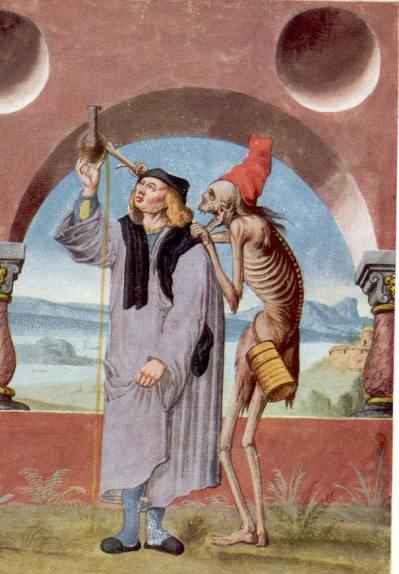
Lægen afbildes altid med et uringlas, som han holder op
mod solen for at undersøge for sygdomme.
Når Døden taler om ȝowre vryne (din urin), er det spørgsmålet,
om det er lægens egen urin, der undersøges.
Bemærk, at Døden i Paris (øverst på denne side) hiver i lægens tøj i skridthøjde. Billeder til højre er fra en dødedans
i Bern (Svejts), hvor lægen selv griber sig i skridtet. Måske for at vise, hvor urinprøven kommer fra.
Sammenlign med lægen i Holbein's dødedans-alfabet
og Holbein's store dødedans.
Simon Vostre: l'amoureuse

|
Den kærlighedsfulde adelsdame er — som de andre kvinder — Lydgate's tilføjelse.
I Paris var der ganske vist en
l'amoureuse, som en slags modpart til
"l'amoureux", den mandlige frier,
men kvindernes dans var en senere opfindelse.
Det ældste daterede manuskript med kvindernes dans er fra 1482.
Den parisiske "l'amoureuse" er en mere tvetydig figur,
da hun i teksten bliver skældt ud som prostitueret,
mens Lydgate tydeligvis har tænkt på sin
"Gentilwoman amerous" som et kvindelig modstykke til
"the amerous Squyere".
 Døden fra Lübeck
 St. Pauls i London
Læge, adelsmand & adelskvinde
St. Pauls i London
Læge, adelsmand & adelskvinde